

The Delight Detective’s guide to breaking the rules
By embracing movement over perfection, driven by curiosity, a desire to disrupt the ordinary, and noticing the mundane, I disrupt my own creative practice
This piece is part of the “in conversation with my image” series.
The most profound obstacle to creativity isn’t a lack of talent; it is the suffocating weight of “good practice.”
I hope that got your attention - it was meant to!
You may or may not agree, but hear me out.
Starting out
Regardless of the artistic mode we work in, we are taught that “art” means we must adhere strictly to rules, master certain techniques and focus relentlessly on a flawless, finished product that is perfect enough to put out into the world. Of course, when we start out, we need to learn the basics of our craft from those who have come before. We need to become comfortable with our tools and build our skills. This is the phase where we replicate because we love how someone else does things, how someone else’s work looks, how that work makes us feel. That’s why there is a thriving industry of artists teaching their methods and techniques. I’m not saying this is wrong - it has its place - this is where we get started, where we learn our craft and skills.
Starting to experiment
Hopefully, there comes a point in the replication process where we start to experiment. If we want to develop as an artist, this is the important phase and where we need to pay the most attention to what’s happening in our practice and how this makes us feel in our bodies. This is when I started feeling the tingles and excitement.
This is where we start to be an artist.
We need to break away from how others do it, and do it our own way. It’s time to mould all that learning and those principles into our own practice, one that suits our individual context, style and physiological make up. If we stay on the path of “doing it by the book” or doing it “so and so’s way” forever, it can lead to “stuckness” and stagnation - a reluctance to produce our own art, or develop our own creative practice, that reflects who we are at our core. There is something in the idea that sometimes, to find the “new,” we must break the old.
At some point, our art needs to become part of who we are.
The practice of being a Delight Detective
To dismantle the trap of perfectionism, and break away from the rigid path of “shoulds” and rules, I stopped being a technical photographer long ago and started practicing being a “Delight Detective”. Yes, I know how to use my camera, to compose images - but those things are now intuitive, rather than technical. They have become part of me.
I rely heavily on playful, delightful disruption as an antidote to creative stagnation. As a Delight Detective, I take my mission seriously to not replicate an existing aesthetic or to blindly copy someone else’s methods, style or practice but to celebrate serendipity and embrace the pull of curiosity and the chaos of my own process! Shifting my focus from the “finished” to the “fluid” allows me to literally become obsessed with the process of being curious.
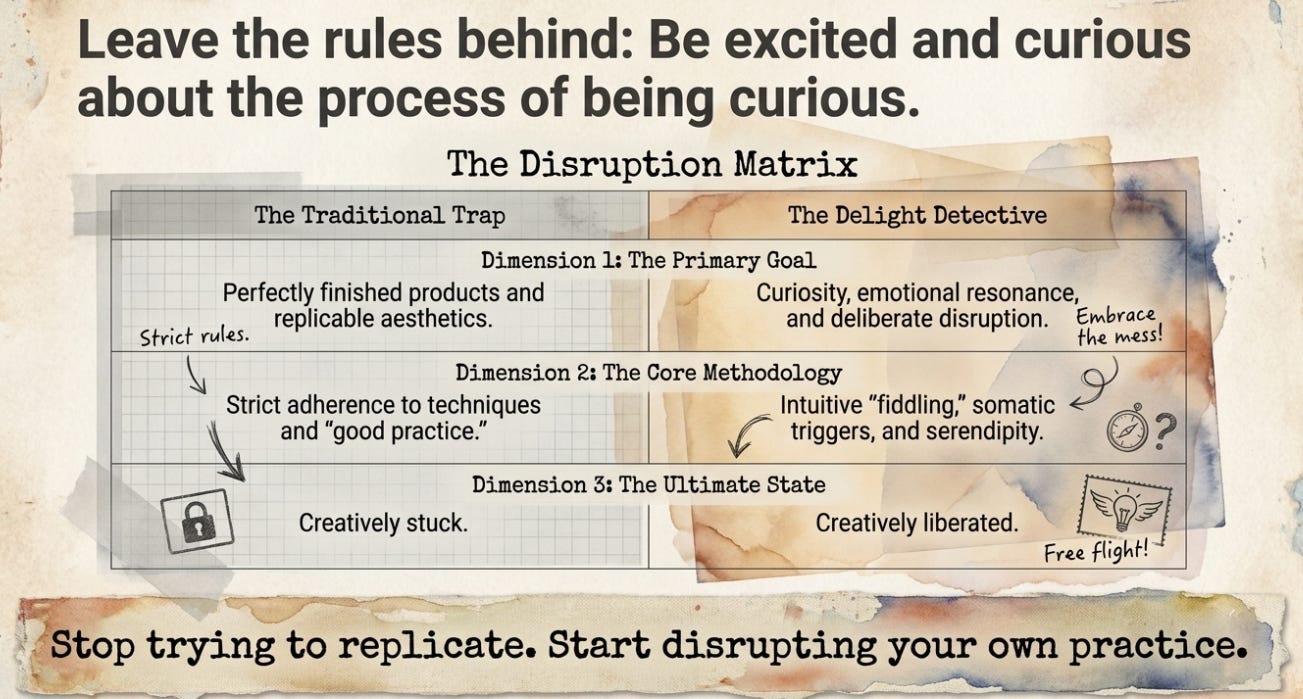
My Disruption Matrix
I’ve created a Disruption Matrix to help you see how being a Delight Detective differs from a more traditional approach specifically with regards to photography - but this could apply to other artistic spheres. I’ve simplified it for this post.
The Traditional Trap
The primary goal: Flawlessly finished products and uniform aesthetics, possibly in an accepted style or form, or using a certain technique.
The core methodology: Strict adherence to established techniques and “best practices”.
The ultimate state: Leads to creative stagnation. Images that look the same as everyone else’s, because, lets face it, we all have a camera at hand these days, don’t we?
The Delight Detective
The primary goal: Curiosity and intentional disruption.
The core methodology: Being open to what comes in the moment through intuitive exploration, somatic triggers, paying attention to the minutiae of daily life and serendipity. Embracing the mess!
The ultimate state: Creative liberation in my own practice.
Because I intuitively know the practicalities of taking a photograph and am comfortable with my tools, by working in this way for well over 10 years, I have found that I actively disrupt:
Traditional technical rules and “good practice” by paying attention in my own way
The expectation of literal representation: a pretty image, a sweeping vista or a conventional portrait
The hollow concept of a “flawless product” because let’s face it, we can chase this forever. “Good enough and done” is the goal, guided by the question: will the final image encourage viewers to have a response to it?
A call to curiosity
I opt for movement over perfection. For me, in my everyday practices of photography, mapping and mixed media art, the final outcome is secondary; the journey of curiosity is what I am chasing and never knowing how an image (or piece) will actually turn out.
The serendipity of “not knowing” is what keeps my practice alive.
Over to you
How does your creative practice feel at the moment: stagnant or alive? Would you be prepared to abandon the pursuit of the “right” way and instead revel in the joy and delight of discovery, Delight Detective?
Stop trying to replicate. Start disrupting your own practice.

Related pieces
This piece is part of the “in conversation with my image” series. My hope is that this series will encourage others to see creativity as a dynamic force fuelled by curiosity and disruption. By sharing my insights, I aim to inspire others to embrace their creative chaos for discovery and innovation.


Looking for updates from my studio?
The Moodling Letter is where I share what I’m working on - from photography and mixed media pieces to hand-drawn maps - along with invitations to exhibitions, open studio days, and workshops (both in-person and online) where you can experience or take part in the process.