

8 reasons why I use visual journaling to gather 'data'
Why gather before you map? 8 compelling reasons for taking up a visual journal practice, specifically for personal mapping or... for paying attention to your life
Another Sunday Pocket Note diving deeper into a visual journaling practice specifically for personal mapping or … for paying attention to your life
Last time, I talked about how, before you make a personal map, it helps to have something to map from - some raw material. I’m suggesting that the raw material is gathered in a visual journal before possibly turning it into a personal map.
This article is inspired by a conversation I had with a new friend earlier this week. I was talking about why visual journaling is so important to me, and why it could benefit others too. This is the gist of the conversation:
Not only is it hard to wrangle our own thoughts and ideas, but we are also bombarded with all the information that modern life throws at us every second of the day.
Something must give, and for me that means getting some of the stuff out of my head and onto paper, so I can make space in my overloaded brain for other things to take hold.
This is where a visual journal comes in, allowing you to pay attention to what keeps catching your attention. Over time, the journal may become a place where you can see what keeps coming up, what changes, what is unresolved, what becomes clearer, and what might be ready to map, if you decide to go that route.
8 compelling reasons for a visual journal practice
Here are 8 compelling reasons for taking up a visual journal practice, specifically for personal mapping.
Attention is the starting point
Paper slows things down
Marks made with pen on paper help us think visually
We gather personal data, relevant to us
Memories need springboards and bridges
Your own stories can surface
Things can stay open, unresolved
Patterns have time to emerge
Each is unpacked below if you want to dive into the details.
1. Attention is the starting point
In my world, attention is a way of becoming more present to my own life. When we give something our attention, we pause. This space helps us see what is actually happening, not just what we assume is happening. It helps us notice what we are drawn to, what we avoid, what keeps coming up and what is shaping our choices behind the scenes.
The pause, allows us to become more aware and to make choices from an intentional response not a reaction. All of this gives us more to work with when we begin mapping, because we are starting from what we’ve already paid attention to; some raw data, not a blank page.
2. Paper slows things down
Engaging with pen (or pencil) and paper slows things down. Research has shown that handwriting is like a full-body workout for your mind. It activates a broad network of brain regions, including those responsible for movement, spatial awareness, and memory. This is because writing by hand is more cognitively demanding than typing; your brain has to work harder to process the information, which makes it “stick” better in the long run. That's why I recommend an analogue, paper-based visual journaling practice. [Read more: Why I Write By Hand]
2. Marks made with pen on paper help us think visually
Not only do pen and paper help us to slow down, but the marks we make are important too. Think about the marks we make with a writing instrument: lines, a circle, arrows, a crossing out, a frame, dots, hatching patterns, a scribble, a repeated shape, an edge.
Making marks on paper is a form of thinking (called Embodied Cognition). The science behind this is that creative thinking doesn’t just happen inside the brain; it emerges through physical interaction with the world. The act of moving your hand over paper to create a mark directly contributes to how ideas are formed in the brain. How cool is that?
Making marks helps you think with the page. By arranging things next to each other, or separating them, or connecting them or visually emphasising them in some way helps us see how information, ideas, thoughts and experiences relate and connect to each other.
3. We gather personal data, relevant to us
Like I mentioned, our lives are stuffed with more data than we have ever had to deal with, not only from external sources but generated every second we experience life. Yet, we struggle to access most of it because unfortunately, by default, we cannot seem to retrieve it neatly when we need to. As we experience it, it comes to us in dribs and drabs as thoughts, memories, moods, reactions, places, images, questions, habits, conversations, decisions, irritations, longings …
A visual journal gives you somewhere useful to collect that data so you can retrieve it when you need it, albeit in a raw format. A map needs material to work with: it needs names, places, dates, connections and more. Its there, ready to be used in future.
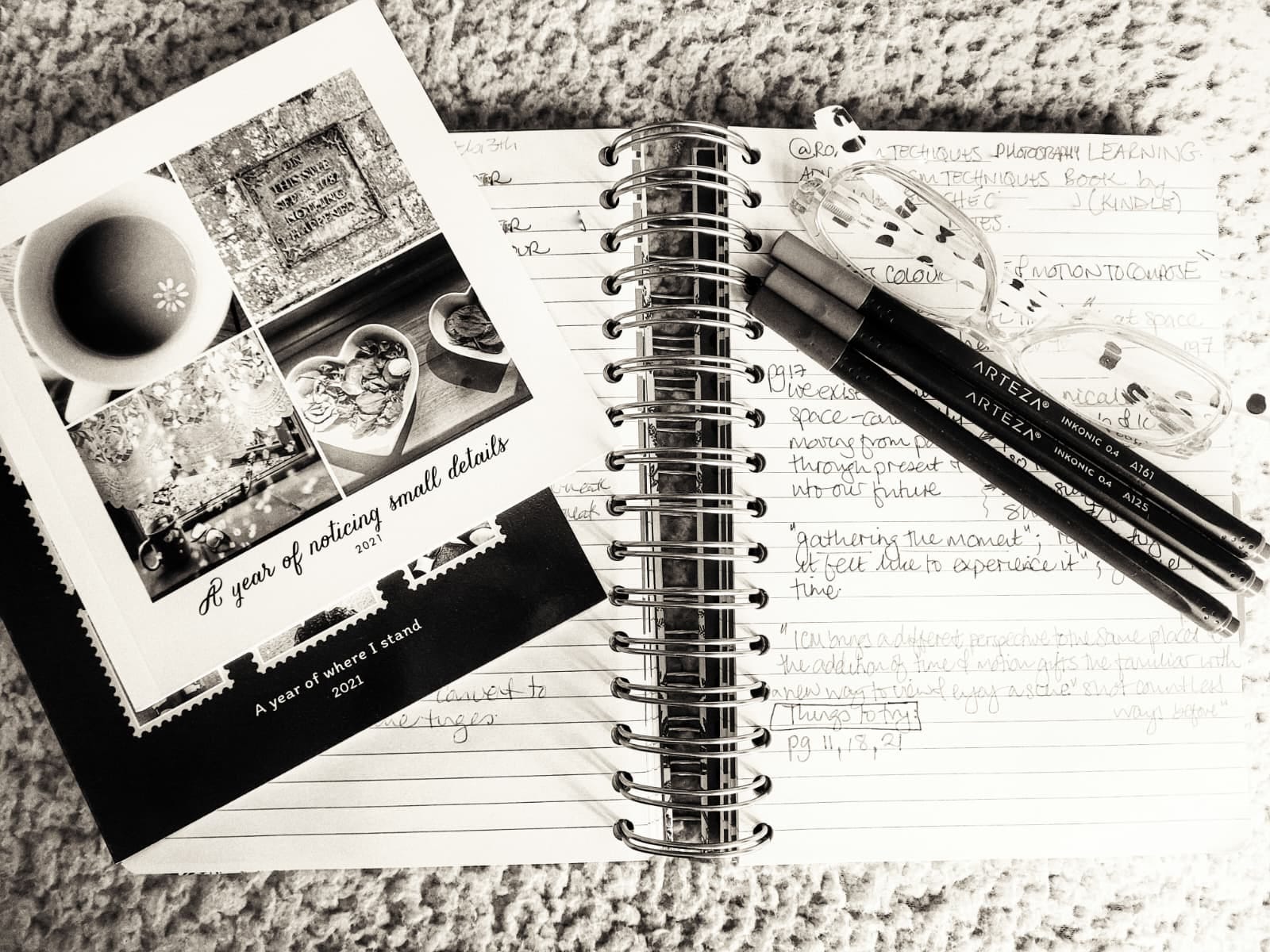
4. Memories need springboards and bridges
Our pasts can often feel a bit messy and disjointed. But random noticings and things can bring the past rushing back: smells, songs, a favourite comfort food. A visual journal helps you build a relationship with your own memory (which can sometimes be a bit flaky) by creating specific remembrances and points in time that can act as springboards for future, deeper, curiosity-driven explorations.
A note you’ve made in a journal about a street, a colour, a room, a conversation or a feeling can unexpectedly become a bridge back to something you might have completely forgotten about. The past needs bridges like this.
The visual journal gives those random noticings a container to live inwithout needing to explain them - you can simply collect them, for now. You might find connections to them later … or you might not.
6. Your own stories can surface
I believe that if you don’t make space to pay attention to your own life, it is way too easy to inherit ready-made stories about who you are, what you value, what happened, what you are allowed to want and what is important to you.
A visual journal lets you collect your own evidence about your life and for you to decide what it means. It gives you a place to write, to question what you write about and be curious rather than judgemental.
7. Things can stay open, unresolved
Often we get so hooked up on what things mean that we close down the channels of possibilities before we've even started. To keep those channels open, we can capture it in your journal (in the way that works for us in that moment) before we try to give it meaning.
The journal lets possibilities exist and stay open for a while so that a question can remain a question and a list can be a list without becoming a fully fledged project plan, or a problem that needs to be solved now.
8. Patterns have time to emerge
Life patterns and themes often need time to show themselves - again, they don't appear as fully packaged aha moments. Sometimes we just need to write down singular, random things. If three similar notes pop up in your journal, that might suggest a theme.
This is why gathering raw data before you start to make maps is a key step in personal mapping. By giving your attention space to let things flow and just sit there for a while, you are not forcing meaning or clarity, or letting your inner critic make unsolicited judgements.
A visual journal helps to give shape to the process of paying attention before you even know what you are going to map. It becomes a place to collect evidence from your own life, if you will: the thoughts, memories, images, questions, habits and patterns that may eventually show you what is ready to be mapped and to be seen
Your turn
Which of these 9 reasons catches your attention first?
Over the next 12 weeks, starting with the next post, I’ll share a series of visual journal starting points, designed to help you gather what might one day become map material. Leave a 💚 if you’re keen to explore with me!

You can support me by signing up for a paid subscription, liking, restacking and sharing my notes and posts. For the price of a coffee, you can also support me through my Buy Me a Coffee page ⬇️

Join me in the Moodling Letter
Every Moodling Letter begins with something I’ve been noticing. From there, I follow the thread to explore what it reveals about attention, creativity and the way we make sense of our lives, alongside new work from the studio and invitations to moodle with me at exhibitions and or through workshops.
Sunday Pocket Notes are small reflective postcards: moments of curiosity, insight, and exploration from inside Mappery, with small practices, ideas and prompts you can take into your own visual journal.
You just inspired me to come back to visual journalling. I used to do it, esp in covid times. I love looking back what I did back then. But it didn’t come easily to me. I’m a drama teacher + performer, so sitting down with myself can be hard. Do you ever publish parts of your journal here?