

Why I write by hand
How handwriting helps me moodle on the page - notes on handwriting, visual journaling and gathering material for personal maps
※ Visual Moodling: restoring the conversation between our inner and outer worlds ※
Visual Moodling offers visual, sometimes messy glimpses into my creative practice through all sorts of stimuli. In this post, I’m exploring the benefits of handwriting and how this links to visual journaling.
I write by hand because it works for me, not because it’s trendy or nostalgic.
I write by hand every day. I keep a daily journal. I sit down with my A4 diary on Mondays and plan the week ahead - by hand. I scribble copious lists on sticky notes. I make little zines full of tasks for specific projects. I write workshop scripts by hand because that is how what I want to say sticks in my brain.
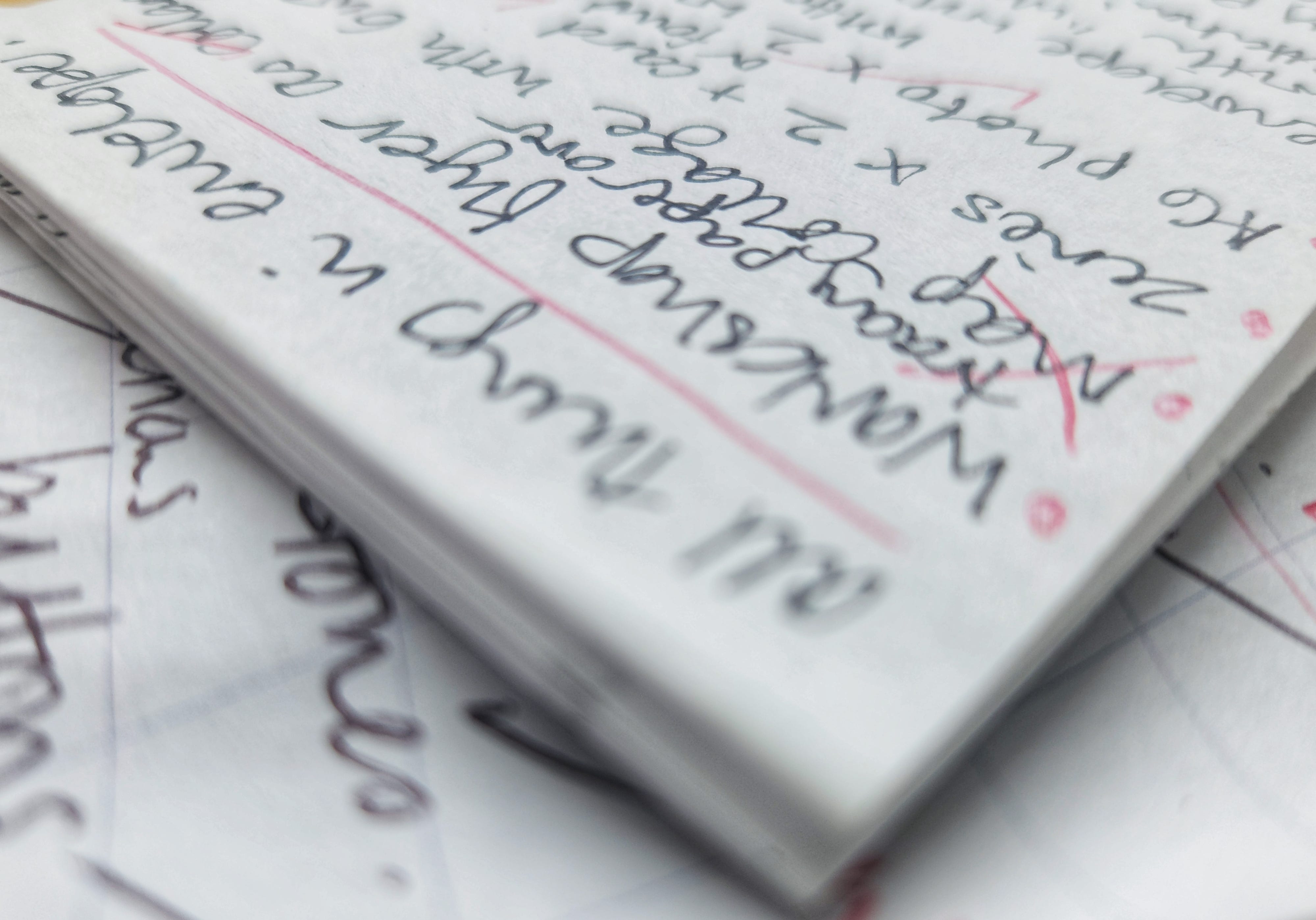
I seldom do any of this digitally anymore, because I find it just doesn’t get embodied in the same way. I can type something out and still feel as if it is floating around somewhere just out of reach - it still niggles at my mind. If I write it by hand, I am more likely to remember it. If something is looping around in my head, putting it on paper helps it become something I can see, move around, circle, cross out - and it gets it out of my head.
Handwriting as moodling practice
Handwriting is woven into the way I think, plan, remember, make things and even slow down. The hand-eye coordination required to form individual letters, to stay on a line - all of that slows me down and makes connections between my hand and my brain. It is part of my moodling practice: a way of letting thoughts and randomly formed ideas exist on a page before they need to make sense or have any clarity.
By handwriting, I give myself both permission and freedom to moodle on the page.
Research around handwriting and the brain
This is why I am so interested in the research around handwriting and the brain. Studies comparing handwriting and typing suggest that handwriting activates broader neural networks that are linked to movement, sensory processing, memory and spatial awareness such as the Hippocampus, the Parietal Lobe and Cerebellum. That makes sense to me. It explains something I already feel in practice: handwriting is a mind-body action.
In our modern-day rush to be efficient, we often forget that speed can be the enemy of reflection. The blinking cursor of a Word document demands immediate, linear progress. In contrast, adding handwriting to the blank page offers “visual flexibility” providing some necessary “breathing room” for synthesis of our thoughts, giving us space to use arrows, sketches, make margin notes, leave gaps and other non-linear marks to connect our disparate ideas together.
Handwriting and handwritten items change the pace and shape of thought.
Connections between visual journaling and handwriting
That is where visual journaling becomes interesting. It uses the strengths of both the hand and the page: hand-eye coordination, movement, spacing, symbols, words and marks. It gives your thoughts more than one way to show themselves, and gets them out of your head.
This is also why I think visual journaling in analogue format, using paper and pen/pencil is such a useful preparation for personal mapping. The action of writing, making marks etc in a visual journal not only gives the early material physical form but also triggers all those other neural networks as we connect pen to paper. We are working with all of it through the body.
If we want to pursue personal mapping, this is important. I’ll be exploring this is much more detail in a series of upcoming posts.
Your turn: try a handwritten experiment
Set a timer for ten minutes and grab an empty piece of paper.
In the middle, write one phrase that has been looping in your mind lately.
Then let your hand respond around it:
a short list
words
arrows
circling
shapes or symbols
leave gaps
cross something out
write sideways if you want to
At the end, look at the page and ask: What did my hand pay attention to whilst my head was looping around?
Do you write or type, and why?

Free Stuff
Interrupt the whirlwind: A moodling practice for paying attention to your day
Join the 7-day Alchemy of Listening series: Experience the world with slower, deeper attention
Make your First Map: A 20-minute guided mapping exercise to express a single life experience visually and simply
Some of the research I refer to
Looking for updates from my studio?
The Moodling Letter is where I share what I’m working on - from photography and mixed media pieces to hand-drawn maps - along with invitations to exhibitions, open studio days, and workshops (both in-person and online) where you can experience or take part in the process.
