

Thinking visually, on paper
I’m proving to myself over and over again that thinking can happen in a myriad of unexpected ways, and yes, its moodling too!
※ Visual Moodling: restoring the conversation between our inner and outer worlds ※
Visual Moodling offers visual, sometimes messy glimpses into my creative practice through all sorts of stimuli. This week I had the idea to show readers what visual journaling can look like. In the end, the page wasn’t just an example - it was my thinking, in visual form, on paper.
It’s been a hot and frustrating week and I needed to step away from the looping thoughts in my head, so I started a random visual journaling piece using what was lying about on my studio desk.
I was inspired by Hannah Two 80s tech inspired zines this week and at the back of my mind was the intention to show you what analogue, visual journaling looks like for me - I wanted you to see an example, rather than trying to keep describing it with words. There was a vague sense of needing to document my week, but as always, I had no idea what I wanted the piece to look like at the end.
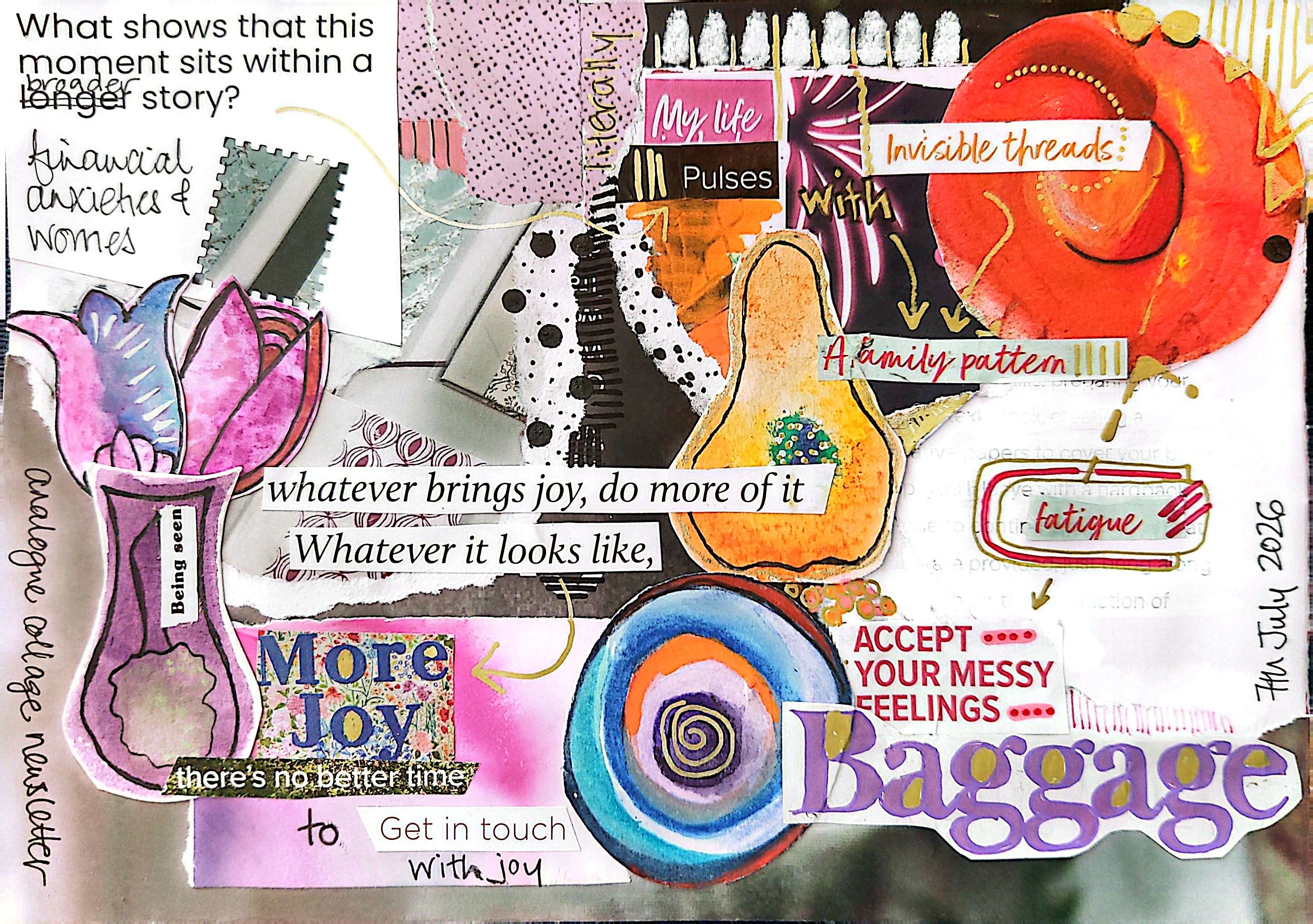
Haphazardly, I grabbed bits of collage fodder from the heap of discards in the tin on my desk and then cobbled together a usable background by tearing through two bigger pages, gluing the jagged outlines together.
Fatigue. Invisible, sticky threads. Family patterns. Joy. Baggage. Financial anxieties. ‘Found words’ that just felt right for how I was feeling in the moment. Placing them where they wanted to belong, instead of forcing myself to arrange them in a pleasing composition. Naturally some words gravitated towards each other, forming clusters of ideas.
As I settled into the task, I could feel myself slowing down and sinking into myself, paying close attention to how I was feeling (in my body and emotionally), and to what has been desperate to be said out loud all week. My body and instincts took over. I was thinking on the page and no longer making an example layout to show you.
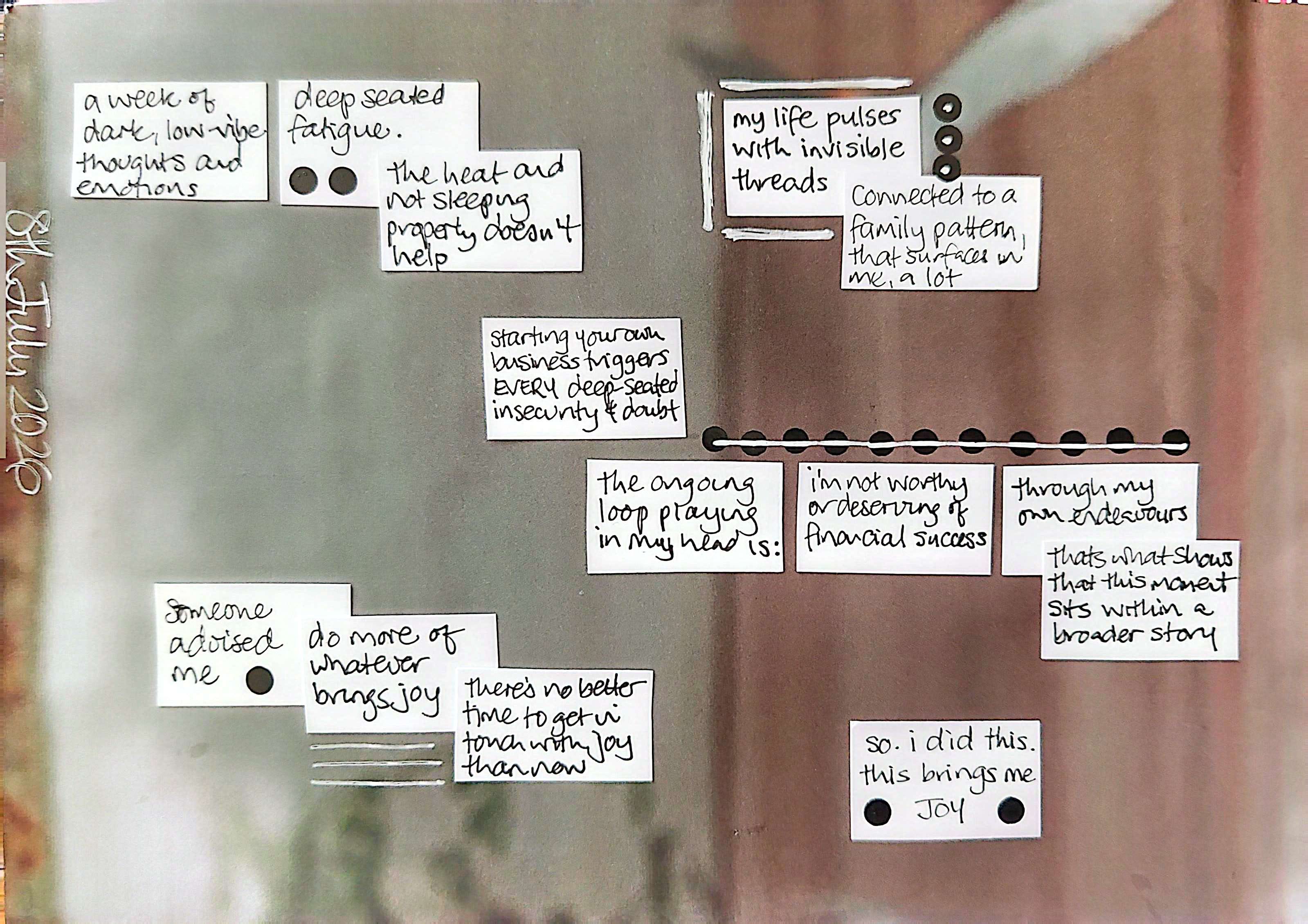
The following day, I noticed a pile of tiny offcuts (3cm x 2cm) and found myself writing the story out on those, limiting myself to more or less 100 words, if I could. I turned the collage over and glued these on the other side.
[⬇️ As a playful aside, can you spot the six-word story hidden here? ]
Contemplating both pieces
The handwritten version follows my thoughts and ideas, in a linear story, beginning with a difficult week, tracing its way through deep-seated beliefs about worth and financial success, noticing how those beliefs connect to a much older family pattern and ends with a deliberate choice to seek out joy.
The collage tells exactly the same story, but differently, helping me understand why my week has felt so bleak. In this version, the elements exist in a less linear fashion. ‘Fatigue’ sits isolated in its own sea of white. ‘A family pattern’ nestles next to shape, colour and movement in the form of arrows. ‘Joy’ has equal weight as another thread running through the left section, not positioned as a reward or conclusion at the end. ‘Baggage’ for some reason, shows up much larger than I consciously intended and I still wonder why it’s there. The arrangement of the items carries meaning and becomes part of my thinking, but also the flow of the piece.
Moodling is always about paying attention
“Ha”, I thought, “I’ve been Moodling again but this time visually, on a page!”1
Moodling is always about paying attention. Curiously following the threads, waiting patiently to see if patterns pop up. Turning off the judgemental voice of Mergatroid2 (my inner critic) and letting my instinct take over.
Since I started studying as an adult, I’ve known that thinking doesn't only happen in sentences and writing, although this has been my fall back position for many years. Now I’m proving to myself over and over again, that thinking can happen in a myriad of unexpected ways, often driven initially by embodied responses, as was the case here. That in turn drives how the thinking unfolds next: sometimes through colour and shapes, through placement of collage fodder, and the proximity and distance between those chosen elements. It even happens when a word cut out of a magazine years ago suddenly serendipitously, represents exactly how I feel today.
Like most of my discoveries, I discovered another way to Moodle, this time visually, on paper
On Sunday, in my Pocket Notes, I’ll share eight reasons why a visual journaling practice helps us notice patterns, make connections and pay attention to our own lives in different ways.
Until then, let me know if you found the six-word story, drop me a comment or a 💚 if you’re enjoying these articles.

Related posts


You can support me by signing up for a paid subscription, restacking and sharing my stories and posts. For the price of a coffee, you can also support me through my Buy Me a Coffee page ⬇️

Join me in the Moodling Letter outside Substack
Every Moodling Letter begins with something I’ve been noticing. From there, I follow the thread to explore what it reveals about attention, creativity and the way we make sense of our lives, alongside new work from the studio and invitations to moodle with me at exhibitions and or through workshops.
Who the bleep is Mergatroid? ➡️ Let me introduce you to Mergatroid. She is the voice of my left brain, my acquired mind, the Inner Critic, my Ego if you like. She is the product of my conditioning. She judges. She interferes - incessantly! She is the one who whispers sarcasm and other terrible comments into my ear. In her own way, she is just trying to protect me from making a fool of myself!
I love this ♥️ especially reading about how the materials speak to you. This part really spoke to me - "My life pulses with invisible threads" 😍
“Do more of what brings you joy”. Hope this proved cathartic, Debs. Brilliant creativity and brave, admirable openness about your inner thinking. Fabulous work.